
March Madness – Survival of the Fittest

Investing is a competitive arena where the fittest not only survive, but thrive.  The NCAA basketball tournament brackets were released Sunday and the playoffs start today – the men’s and women’s teams are ranked 1-16 in 4 regions respectively.  In the stock markets, there is always someone in first place and someone in last place at the end of the trading day.  On April 8&9, those 64 teams will have been reduced down to one winner each.  On any given day, you can rank the daily returns of each stock within a given index.  Investing is not a zero-sum game like most gambling or trading of options or futures contracts.  Wealth can grow within the stock market, but score is still kept on a relative basis.  If you evaluate a group of investors or mutual fund managers, someone always ends up in first place, either making the most money in the up market, or losing the least in the down market.  There is also always someone in last place, and everyone else who falls in between.  In a world of buyers and sellers, there are 2 sides to the trade, and being on the right side at the right time is critical for success.  People invest for one reason: to make more money.

Each investor has a limited number of dollars to put to work, so it is critical to develop a selection strategy that will single out the best performers within a given asset class.  For everyone who makes money, generally there is someone losing (unfortunately it is often the individual investor – look at how many people sold their stocks and funds at the bottom of the market in 2009 locking in losses, sat on the sidelines in cash, and missed the recent 100% returns!).  America was born on capitalism, free-markets and competition.  Stocks, bonds and derivatives are merely tools for the transfer of assets, obligations and currencies.  Aside from our health and physical well-being or spiritual state, our financial condition is often the most significant driver of our quality of life.  Most people do not need gobs of money to effectively care for their families, but after the turmoil of the markets over the past two decades, I have seen families shattered and emotionally devastated by a few wrong moves.  Lack of knowledge can cause us to be on the wrong side of the trade at the wrong time.  An objective strategy, discipline, and a focus on quality investments can put the odds in your favor.  Many NCAA teams focus on fundamentals and stick to basic strategies, and just wait for their opponent to slip up.  That consistency often separates the winners from those who fail to advance.  And always beware the bracket-busters – which is why diversification is critical for even the highest quality portfolio.

© 2012-2013 Pawleys Investment Advisors, LLC.  All rights reserved.
2012 PGA Championship at Kiawah and Stock Picking

After several hours watching the world’s best golfers at the Kiawah Island Ocean Course here in South Carolina, it again hit home how difficult it is to deliver consistent, top-level performance.  The professional golf scene this week at Kiawah is akin to investors selecting a portfolio of quality stocks that will deliver solid financial performance in the long run.  Sponsor advertising from corporate consulting firms, investment banks, and even luxury watchmakers, messages this theme to golf fans.  When VJ Singh, one of the leaders during the week, worked at the driving range, he used a shaft embedded in the ground to the side of his body.  The purpose of this tool is to check the plane of his swing and eliminate variation.  Use of such a tool is an attempt to develop swing consistency and rhythm.  Kiawah Island and the links-style Ocean Course is known for extreme weather conditions coming off the Atlantic.  Similarly, the equity markets are riddled with extreme conditions.  Investors should also use such tools to develop consistency in basic skills to master the science of stock selection.  Using a well-defined structure for the portfolio, combined with a consistent process for selection and for both buying and selling decisions (not to mention the timing,) will better position investors to minimize the variations that can lead to poor performance. 

The weather on Friday, which included howling winds, led to poor scores overall, but four players excelled and delivered under par numbers.  A few select investors have continued to deliver solid performance this year, even as the howling winds of the European debt contagion have swept over global equity markets (including the Pawleys Dividend Portfolio and the Pawleys Growth Portfolio, see the Q2 update for specifics).  Stay tuned for more tips and learn how to master the basics (the “science”) and eventually, with experience, hone your ability to use “art” to supercharge your results.  Golfers refer to this as “feel” or “touch” and it is what helps these professionals stay at the top of the leaderboard.  Enjoy the PGA 2012 Championship tournament and the hunt for the Wanamaker trophy!  The golfers all have diverse styles that they each own.  You can use a putter, a driver or a seven iron off the fringe of the green, and each can be used with success.  Think about how the tournament environment can help you hone your strategy and processes in managing your stock portfolio.  Stay tuned for more as I share the specifics of equity portfolio construction…and be sure to watch for the alligators snatching the ground television microphones off the tee boxes!

© 2012 Pawleys Investment Advisors, LLC.  All rights reserved.

Crowdsourcing Yourself out of Retirement

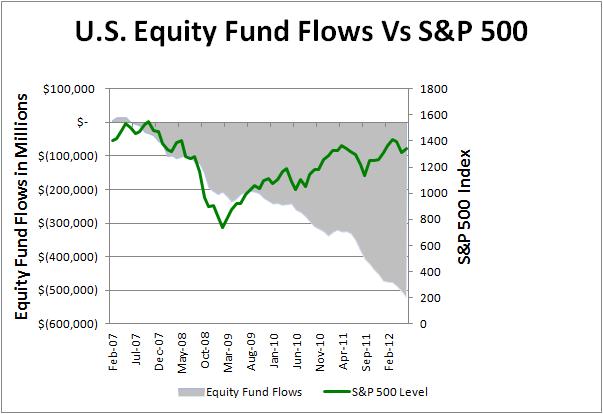
Sadly, over $300 billion has flooded OUT of domestic equity mutual funds since early 2009, while the S&P 500 has risen over 80%.  Many S&P stocks also pay a dividend, currently averaging around 2%, which certainly beats the interest offered by savings accounts, bank CD’s and short-term bond funds.  The S&P is rising despite these mutual fund liquidations because “smart money” continues to flow into individual stocks.  While I cannot predict the future short-term trends of the economy and markets, what I can tell you is that over the past few years the herd mentality has been wrong once again.

The shaded grey area represents the cumulative dollar value of redemptions of domestic (meaning U.S.) equity (meaning stock) mutual funds.  The left side axis shows the amounts in millions of dollars that matches the shaded grey area.  On the right axis, the line shows the level of the Standard and Poor’s 500 index, which measures the level of the stock market (the green line).  You can see where it hit a low on early 2009 (the dates are shown at the bottom of the chart) and has since steadily risen in a slightly bumpy line.  As the green line rises, the grey area has swollen as frightened investors have sold their funds even as the market has continued up.  😦

Sources: Investment Company Institute, Interactive Data.

© 2012 Pawleys Investment Advisors, LLC.  All rights reserved.